 EN
EN
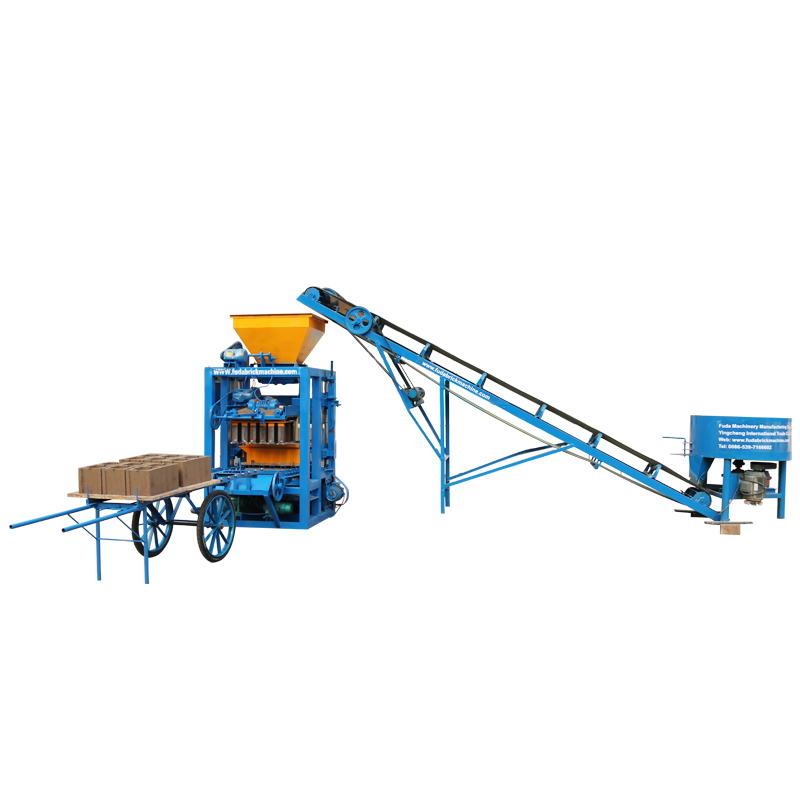
PLC-Based Automation: The Core Intelligence of Fully Automatic Hydraulic Block Machines
How IEC 61131-3 PLCs Orchestrate Cycle Timing, Mold Actuation, and Curing Sequencing
A Programmable Logic Controller (PLC) compliant with the IEC 61131-3 standard serves as the central brain of a fully automatic hydraulic block machine, precisely orchestrating every production step—from material feeding and mold filling to compaction, vibration, ejection, and curing. Sensors at hoppers, mold cavities, and hydraulic actuators feed real-time data into the PLC, enabling dynamic micro-adjustments. For example, if a fill-level sensor detects variation, the PLC fine-tunes hydraulic stroke duration or pressure to maintain uniform block density. During curing, it regulates steam injection timing or ambient conditioning cycles to ensure optimal strength development before demolding. These automated, closed-loop corrections eliminate human variability, reduce average cycle times by over 35%, and cut labor dependency by more than 60%—delivering dimensional accuracy within ±0.5 mm and density consistency under 2% batch-to-batch variation.
Proprietary vs. Open-Source PLC Platforms: Impact on Maintenance Cost and Customization for Automatic Hydraulic Fly Ash Brick Making Machine Price Optimization
The choice between proprietary and open-source PLC platforms significantly influences long-term TCO and operational agility—key considerations when evaluating automatic hydraulic fly ash brick making machine price justification. Proprietary systems offer vendor-backed reliability and pre-validated function blocks but often entail restrictive licensing, costly firmware updates, and limited access to source logic. In contrast, open-source PLCs built on IEC 61131-3 standards empower manufacturers to modify control logic in-house, adapt compression profiles for varying raw material mixes (e.g., fly ash, sand, cement), and integrate third-party diagnostics without hardware upgrades. While integration may require initial engineering effort, five-year total cost of ownership drops 20–30% through avoided license fees, reduced reliance on external programmers, and faster recipe deployment. For producers prioritizing flexibility and lifecycle economics, this architectural decision directly strengthens the financial case for automation investment.
Hydraulic-Pneumatic-PLC Integration: Precision Pressure, Stroke, and Synchronization Control
Real-Time Hydraulic System Feedback Loops and Their Role in Consistent Block Density and Dimensional Accuracy
Consistent block quality hinges on closed-loop hydraulic control. Linear encoders and high-resolution pressure transducers monitor piston position and fluid pressure during each compression cycle, feeding data to the PLC at millisecond intervals. The controller compares actual values against target setpoints—typically within 0.1 mm stroke tolerance and ±0.5 bar pressure—and dynamically adjusts proportional valve commands to correct deviations. This ensures uniform compaction force across all mold cavities, delivering block density variation under 2% per batch and dimensional tolerances within ±0.5 mm. Without such real-time correction, fluctuations in aggregate moisture content or hydraulic oil temperature would cause unacceptable inconsistencies—increasing scrap rates and rework costs. That precision directly supports ROI by minimizing raw material waste and strengthening the value proposition behind the automatic hydraulic fly ash brick making machine price.
Discrete and Analog I/O Architecture: Enabling Adaptive Force Regulation During Compression Stages
Modern PLCs leverage hybrid discrete and analog I/O architecture to manage the dual hydraulic-pneumatic actuation system. Digital inputs confirm cylinder positions via limit switches and proximity sensors; analog inputs capture continuous pressure and load signals from strain-gauge transducers; analog outputs modulate proportional valves for granular force control. During the low-pressure fill stage, digital outputs rapidly open pneumatic vent valves. As compression advances, the PLC ramps hydraulic flow using analog modulation—applying up to 150 tons of force in a controlled, non-linear profile that prevents green-block cracking. This adaptive regulation also enables instant recipe switching: operators select preset profiles for solid, hollow, or paver blocks via HMI, eliminating mechanical reconfiguration. The result is enhanced production flexibility, reduced setup time, and lower long-term maintenance burden—all contributing to improved TCO and stronger justification for the automatic hydraulic fly ash brick making machine price.
Closed-Loop Performance Optimization for Cost-Efficient Production
Closed-loop control transforms static machinery into an adaptive production asset. By continuously monitoring pressure, temperature, stroke timing, and cycle duration—and comparing them against optimized setpoints—the system autonomously adjusts hydraulic force, dwell time, and curing parameters in real time. This minimizes deviation from ideal conditions, reducing scrap, improving throughput, and maintaining consistent quality without operator intervention. Energy use is optimized through variable-frequency drives on hydraulic pumps and intelligent pressure modulation—avoiding unnecessary over-pressurization or idle consumption. Predictive alerts based on trend analysis extend component life for seals, valves, and cylinders while reducing unplanned downtime. Manufacturers implementing these capabilities report 15–20% reductions in energy and material waste within 12 months, with 98% citing operational efficiency as their primary automation driver. These gains directly improve ROI by lowering per-brick production costs—making the upfront investment in a fully automatic hydraulic fly ash brick making machine more financially defensible.
From Manual Operation to Fully Automatic Production: How Advanced Controls Reduce Total Cost of Ownership
Labor Savings, Energy Efficiency, and Uptime Gains Directly Influencing Automatic Hydraulic Fly Ash Brick Making Machine Price Justification
Transitioning from manual or semi-automatic operation to a fully automatic hydraulic fly ash brick making machine delivers measurable TCO reduction—not just higher performance. Advanced control systems replace three to five manual operators per shift, cutting direct labor costs and eliminating variability-driven defects. Integrated energy management—including VFD-controlled hydraulic pumps and adaptive curing cycles—reduces electricity consumption by up to 25% compared to conventional machines. Meanwhile, continuous condition monitoring enables predictive maintenance, extending service intervals for critical components and reducing unplanned downtime by over 40%. Collectively, these improvements—lower labor input, reduced energy spend, and higher uptime—offset the initial capital outlay. Producers consistently achieve payback periods under 24 months and report 18–22% lower per-brick production costs. Far from being a premium feature, advanced automation is a strategic lever that strengthens the economic justification for the automatic hydraulic fly ash brick making machine price.
FAQ
What is the role of a PLC in a fully automatic hydraulic block machine?
PLC acts as the central brain of the machine, orchestrating production steps such as material feeding, molding, compaction, and curing. It also uses sensor feedback to make real-time adjustments, ensuring uniform quality and reducing processing times.
How do open-source PLCs compare to proprietary systems?
Open-source PLCs offer more flexibility and cost savings over time by allowing in-house modifications and integration with third-party systems. Proprietary systems, while reliable, can be expensive due to licensing and limited customization.
How does hydraulic-pneumatic-PLC integration impact block production?
The integration ensures precision in pressure and stroke control using closed-loop feedback systems. This produces blocks with consistent density and dimensions while reducing waste and operational inefficiencies.
What benefits does closed-loop control offer for manufacturers?
Closed-loop control enhances production efficiency by monitoring and adjusting parameters in real time. This leads to reduced scrap rates, material savings, energy efficiency, and consistent product quality.
How does automation reduce the total cost of ownership (TCO)?
Automated systems lower labor and energy costs, increase uptime through predictive maintenance, and reduce defects. These factors contribute to a quicker payback on investment and long-term operational savings.
Table of Contents
- PLC-Based Automation: The Core Intelligence of Fully Automatic Hydraulic Block Machines
- Hydraulic-Pneumatic-PLC Integration: Precision Pressure, Stroke, and Synchronization Control
- Closed-Loop Performance Optimization for Cost-Efficient Production
- From Manual Operation to Fully Automatic Production: How Advanced Controls Reduce Total Cost of Ownership
-
FAQ
- What is the role of a PLC in a fully automatic hydraulic block machine?
- How do open-source PLCs compare to proprietary systems?
- How does hydraulic-pneumatic-PLC integration impact block production?
- What benefits does closed-loop control offer for manufacturers?
- How does automation reduce the total cost of ownership (TCO)?