 EN
EN
Precision Hydraulic Compaction for Dimensional Accuracy and Material Flexibility
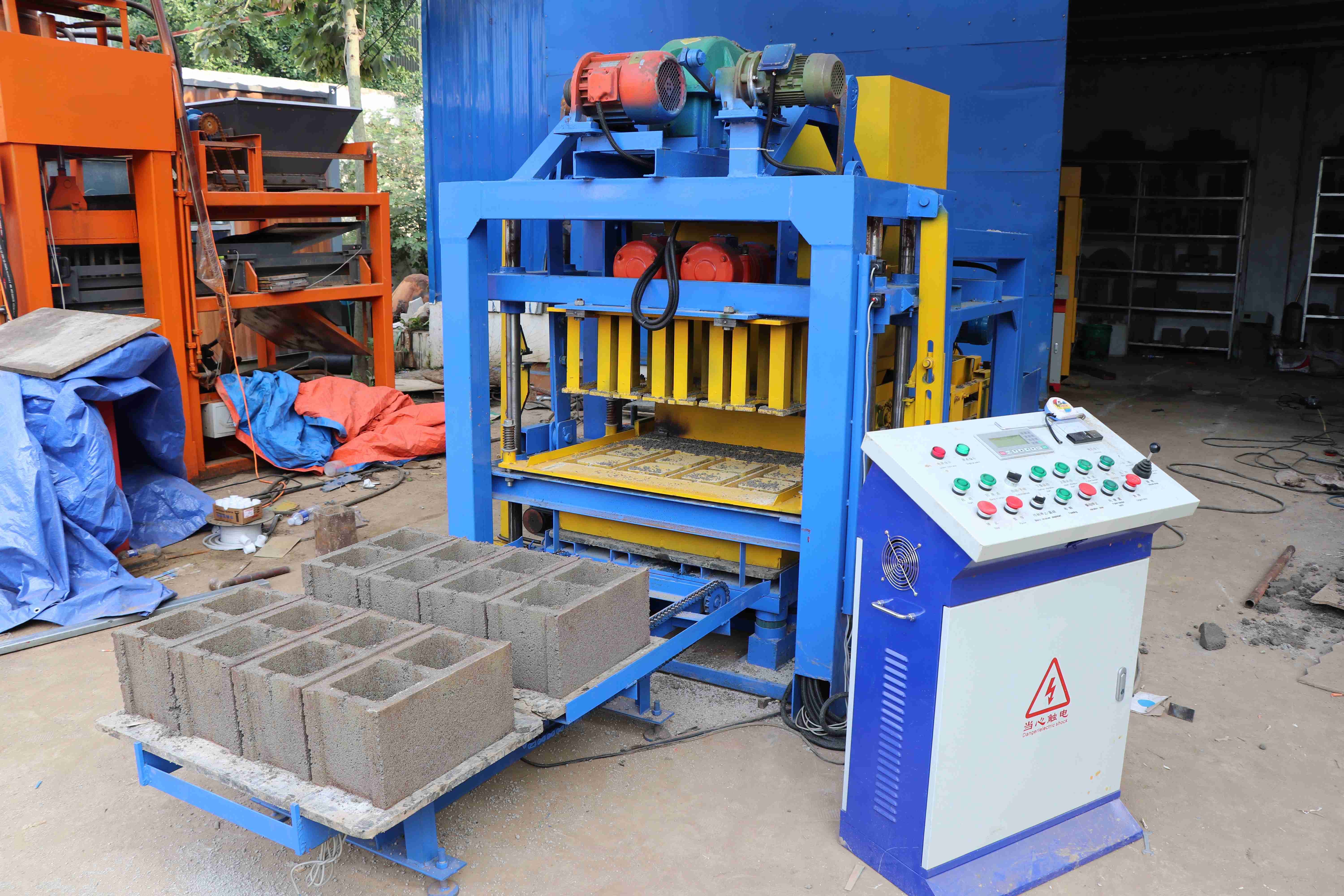
Achieving profitable custom block design starts with precise compaction. Fully automatic hydraulic block making machines use advanced pressure control to produce blocks with tight tolerances and consistent density—enabling reliable output of interlocking, architectural, and specialty blocks while minimizing material waste. When evaluating the automatic hydraulic fly ash brick making machine price, the value of this repeatable compaction performance justifies the investment.
Consistent High-Pressure Control Across Block Types: Ensuring Tolerance Compliance for Interlocking and Architectural Blocks
Interlocking and architectural blocks require dimensional accuracy within ±0.3 mm. Hydraulic systems deliver uniform pressure throughout the compaction cycle—eliminating density gradients that cause warping or misalignment during assembly. Real-time pressure sensors feed data to a closed-loop controller, which dynamically adjusts force to compensate for batch-to-batch variations in moisture or particle size. This ensures every unit meets tolerance specifications, cutting rejection rates by up to 40% in field trials across Indian and Southeast Asian plants. For manufacturers, that consistency translates directly into faster on-site installation, fewer callbacks, and stronger brand credibility.
Material-Agnostic Performance: Reliable Compaction of Fly Ash, AAC, Clay, and Composite Mixes
A single machine must handle diverse raw materials without sacrificing output quality. Hydraulic compaction adapts seamlessly to the flow behavior and compressibility of fly ash, AAC fines, clay, and composite blends—adjusting pressure, vibration frequency, and dwell time automatically to achieve optimal green density. This flexibility allows producers to pilot new formulations (e.g., 70% fly ash + 30% slag mixes) without dedicated equipment. By supporting multiple feedstocks, the system maximizes uptime and slashes changeover costs—key contributors to ROI, especially for regional suppliers serving mixed-material markets.
Rapid Mold Adaptation Systems for True Multi-Format Production
Modern block production demands agile changeovers to serve diverse project requirements without sacrificing throughput. Hydraulic block machines now integrate rapid mold adaptation systems that cut design-switching time by over 85%, directly improving the cost-efficiency of custom block manufacturing.
Tool-Free, PLC-Guided Mold Swapping in <8 Minutes — Validated Efficiency Gains Across Asian Manufacturing Sites
Traditional mold changes involve manual disassembly, alignment, torque verification, and test runs—often consuming 60–90 minutes per swap. Advanced PLC-guided systems eliminate tools entirely: operators select the target block profile from an onboard digital library, and the machine autonomously releases, positions, and hydraulically locks the new mold with micron-level repeatability. Field data from six operational sites across India, Vietnam, and Bangladesh confirm average swap times of 6.2 minutes—with zero recalibration required. This speed enables economical small-batch production (as low as 500 units), turning custom orders into viable revenue streams rather than production bottlenecks.
Modular Mold Interfaces Supporting Hollow Core, Perforated, and Decorative Profiles Without Downtime
Beyond speed, modern mold interfaces prioritize versatility. Interchangeable modular cartridges allow seamless switching between hollow-core structural blocks, perforated thermal bricks, and decorative façade units—all on the same press. Precision-machined interface plates maintain hydraulic seal integrity and mold registration regardless of geometry, eliminating re-alignment or sensor retraining. Operators routinely run multi-format jobs within a single shift—e.g., producing load-bearing hollow blocks in the morning and ornamental cladding units in the afternoon—without interrupting workflow. This capability transforms capital investment into flexible capacity, not fixed asset limitation.
Smart Automation Architecture: From Parameter Mapping to Batch-Specific Curing Profiles
PLC-Driven Recipe Storage: Preserving Density, Vibration Timing, and Ejection Force Settings per Block Design
Every custom block design is stored as a validated digital recipe in the machine’s PLC—capturing target green density, vibration amplitude/duration, ejection force, fill timing, and even post-compaction dwell. When switching from a solid paver to a thin-profile perforated brick, the system recalls and executes the exact parameters—no operator input, no trial batches, no deviation from spec. Over 12,000+ production cycles at certified ISO 9001 facilities show ≤0.8% variation in block weight and dimensions. This repeatability cuts material waste by 7–12% and eliminates setup-related rework—directly improving the cost-per-block metric that determines competitiveness.
Seamless Integration with Downstream Curing & Stacking Systems for End-to-End Custom Block Workflow
Parameter mapping extends beyond the press. The PLC communicates real-time block metadata—including mix type, density, and geometry—to downstream curing chambers and robotic stackers via industrial Ethernet. Curing profiles adjust automatically: high-strength fly ash–slag blends receive extended 8-hour steam cycles at 95°C, while lightweight AAC composites undergo gentle 4-hour ambient-humidity curing to prevent edge degradation. Integrated vision sensors verify dimensional compliance before stacking, triggering auto-correction or quarantine if deviations exceed thresholds. This closed-loop, interoperable architecture reduces total cycle time by 22% and enables true high-mix, low-volume production—without compromising throughput or quality assurance.
Automatic Hydraulic Fly Ash Brick Making Machine Price and Customization ROI Analysis
The upfront cost of a fully automatic hydraulic fly ash brick making machine typically starts at INR 30 lakhs, scaling with capacity, automation grade, and integration readiness. Yet evaluating only purchase price overlooks the strategic advantage: the ability to profitably produce higher-margin specialty blocks—interlocking pavers, acoustic bricks, or architecturally textured units—that command 25–40% price premiums over standard clay bricks.
| Machine Type | Automation Level | Indicative Price Range (INR) |
|---|---|---|
| Manual | Entry-level | 2–10 lakhs |
| Semi-automatic | Mid-range | 10–30 lakhs |
| Fully automatic | Premium/Industrial | 30 lakhs and above |
Most operators recover their investment within 18–24 months—not solely through labor savings, but via three compounding advantages:
- Low-cost feedstock leverage: Fly ash sourced near thermal power plants often carries negligible procurement cost;
- Premium product margin: Custom blocks sell at significantly higher ASPs in infrastructure and real estate segments;
- Operational agility: Rapid mold swaps and recipe-driven repeatability enable responsive quoting, shorter lead times, and stronger client retention.
When combined with smart curing integration and material flexibility, these features transform equipment cost from a line-item expense into a scalable profit engine—delivering measurable ROI long before depreciation cycles conclude.
FAQ
What is the significance of precision hydraulic compaction in block making?
Precision hydraulic compaction ensures tight tolerances, consistent densities, and reduced material waste, enabling the production of custom block designs with high-quality standards.
How does hydraulic compaction handle different materials?
Hydraulic compaction adapts pressure, vibration, and dwell time based on the flow behavior of materials like fly ash, AAC, clay, and composites, ensuring consistent output quality.
What are the benefits of rapid mold adaptation systems?
Rapid mold adaptation systems drastically reduce changeover times, enable seamless switching of block designs, and improve the cost-efficiency of producing custom blocks.
What role does automation play in block production?
Automation optimizes production parameters for each block design, integrates curing and stacking workflows, and ensures high repeatability for consistent results and minimal waste.
What are the price ranges for automatic hydraulic fly ash brick making machines?
Manual machines cost INR 2–10 lakhs, semi-automatic machines range from INR 10–30 lakhs, and fully automatic machines start from INR 30 lakhs, depending on specifications.
Table of Contents
- Precision Hydraulic Compaction for Dimensional Accuracy and Material Flexibility
- Rapid Mold Adaptation Systems for True Multi-Format Production
- Smart Automation Architecture: From Parameter Mapping to Batch-Specific Curing Profiles
- Automatic Hydraulic Fly Ash Brick Making Machine Price and Customization ROI Analysis
-
FAQ
- What is the significance of precision hydraulic compaction in block making?
- How does hydraulic compaction handle different materials?
- What are the benefits of rapid mold adaptation systems?
- What role does automation play in block production?
- What are the price ranges for automatic hydraulic fly ash brick making machines?